What is a hologram?
Understanding-oriented. This is the most important page in the whole set.
Disclaimer: Here, A hologramm is not a glowing 3-D Princess Leia floating in the air, or a moving image on a banknote. We mean something else. Behold.
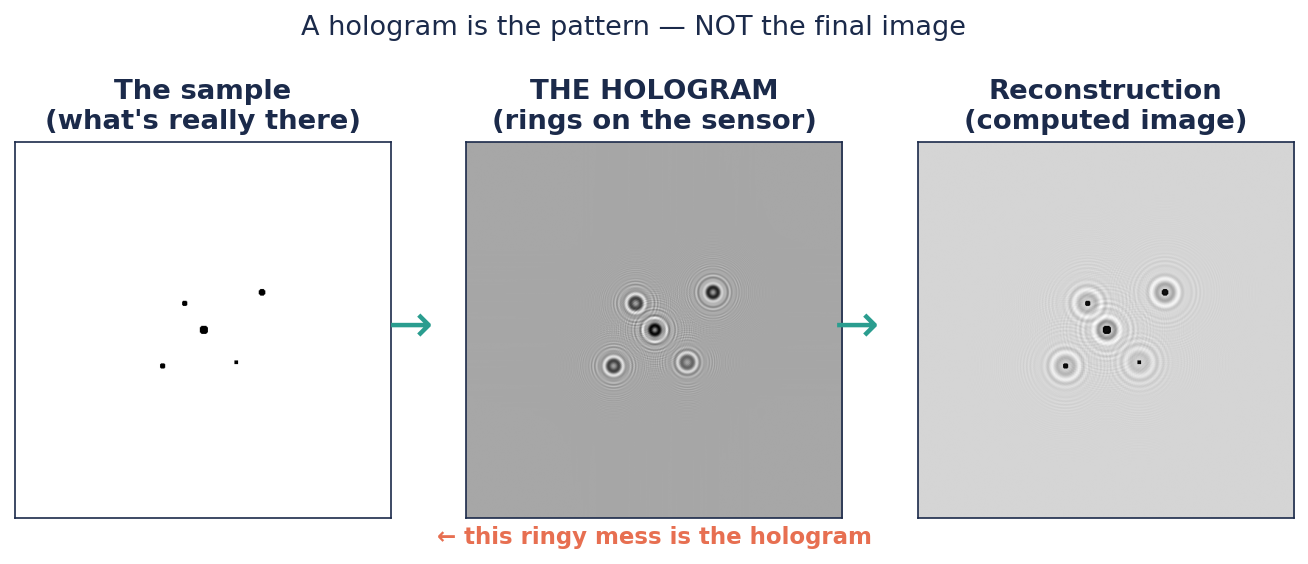
A hologram is a recorded pattern, not a 3-D image
A hologram is the interference pattern recorded on the sensor. It is not the 3-D image you eventually see.
The thing the camera captures looks like nothing — a mess of fine rings and fringes, more like static than a photo. That mess is the hologram. It's "simply" the image of interference under the knowledge of the reference wave (which we can use to reconstruct the unknown scattered/sample wave). The recognisable picture only appears later, after a reconstruction step (done with a lens, or on a computer) turns the pattern back into an image.
It helps to separate two stages that are somewhat blurry
| Stage | What happens | What it looks like |
|---|---|---|
| Recording | The object's scattered wave interferes with a reference wave; the pattern is saved | A swirl of rings — "the hologram" |
| Reconstruction | The pattern is replayed (re-illuminated or computed) to rebuild the wave | The sharp 3-D image |
The 3-D image is the output of a hologram, not the hologram itself.
What makes it special: it stores the phase
An ordinary photograph records only brightness (intensity) — how much light landed on each pixel. It throws away the phase of the wave (see Light as a wave). Once phase is gone, you've lost the information about which direction the light was travelling and how far it had come — so you can never refocus a normal photo after taking it.
Holography's trick is to smuggle the phase back in. By letting the object wave interfere with a clean reference wave before recording, the phase information gets encoded into the positions of the bright and dark fringes. The camera still only records brightness — but now the brightness pattern secretly carries the phase, written in the spacing of the rings.
That is the whole genius of Dennis Gabor's 1948 invention (Nobel Prize, 1971): use interference to turn invisible phase into a visible pattern a camera can record.
A photo records how bright. A hologram records how bright AND, hidden in the fringes, which way the wave was going — and that extra information is what lets a computer rebuild a 3-D image and refocus it afterwards.
Inline holography: the simplest possible setup
The HoloBox uses the simplest form, inline (Gabor) holography. "Inline" means everything sits in a single straight line: light source => sample => camera.
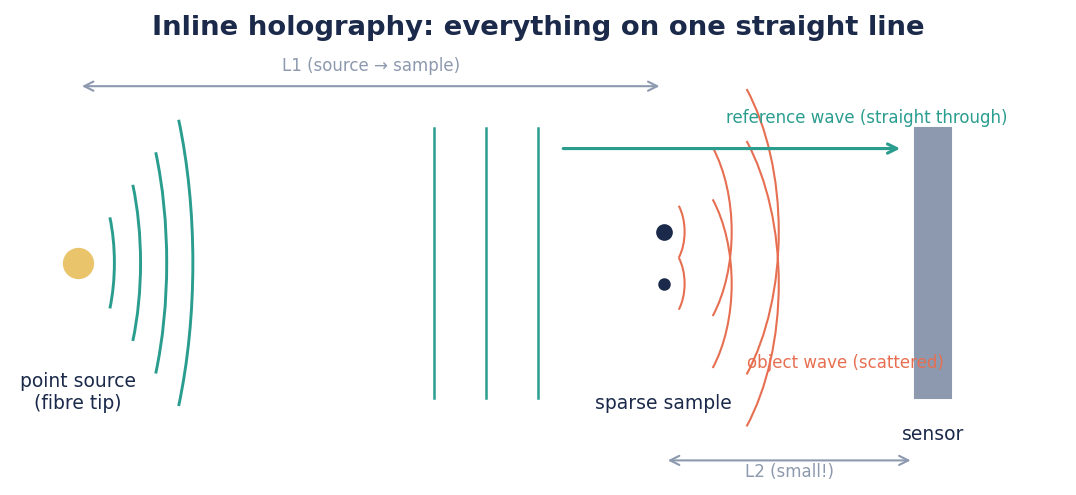
- A coherent point source (LED + colour filter + pinhole) sends out clean waves.
- Most of the light sails straight past the sample untouched, this is the reference wave.
- A little light hits the tiny, mostly-transparent sample and scatters — this is the object wave.
- The two overlap on the camera sensor and interfere. The sensor records the pattern. That's your hologram.
Because there are no lenses, the magnification comes purely from geometry: the closer the sample sits to the sensor (and the further the light source), the more the pattern spreads out and the bigger the reconstructed image appears. This is why the build tutorial tells you to glue the sample almost onto the sensor.
The catch: the twin image
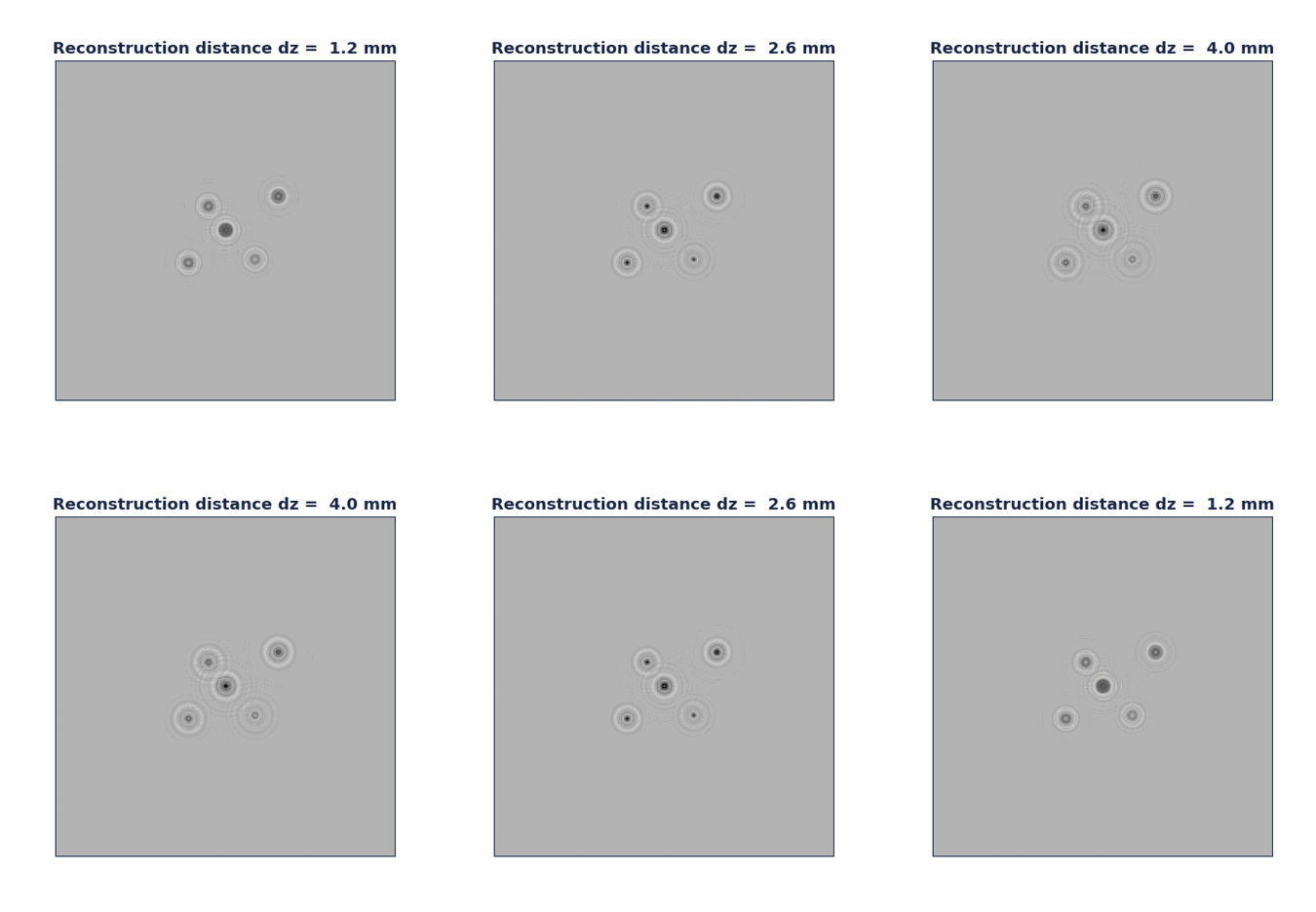
Inline holography has one built-in flaw worth knowing about. Because the camera only records brightness, the reconstruction can't tell whether the object sat in front of or behind the focus plane. So it produces two overlapping images at once — the real one and a ghostly, out-of-focus mirror copy called the twin image. It shows up as a faint halo or ringing around your sample.
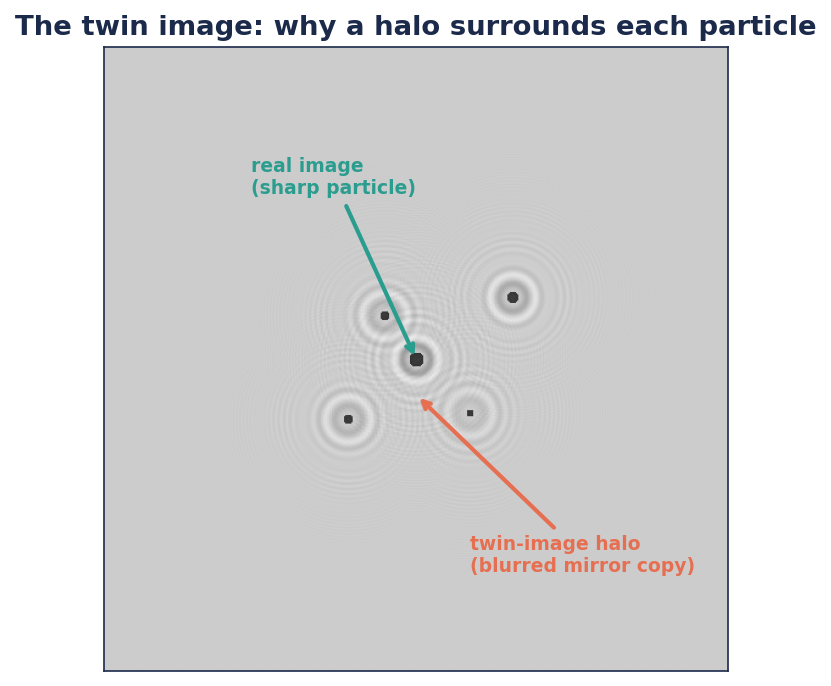
This isn't a mistake you made; it's a fundamental property of the simple inline setup. Researchers remove it with clever algorithms, but for a first hologram it's perfectly fine (e.g. Gerchberg Saxton as it's done in our software) to just see it and understand where it comes from. (More advanced off-axis holography, on the Mach–Zehnder, tilts the reference beam to push the twin image out of the way.)
Holograms vs. the movies
So is the floating-Princess-Leia hologram fake? Mostly, yes — those are usually clever projections or reflections, not true holograms. A real hologram is the quiet, ringy pattern on your sensor. It's less flashy than science fiction, but far more remarkable: it's a photograph that remembers the shape of a light wave itself.