CoreBox for Schools
With the coreBOX youc an build real optical instruments like magnifier, projector, telescope, microscope and understand them from ground up in a Do-It-Yourself-Fashion
The CoreBox is a box of openUC2 cubes with lenses, mirrors, a real microscope objective and a smartphone holder. It covers geometrical optics from the first "why does a lens magnify?" all the way to a working smartphone microscope. It is also the foundation for every other openUC2 Discovery box (Electronics, Infinity, Fluorescence, LightSheet, HoloBox). Curious? Continue reading! :)
The guiding idea, straight from the teaching concept:
"Understand optics by building it."
These pages are written for students and their teachers. No university maths required; the only thing you need is curiosity.
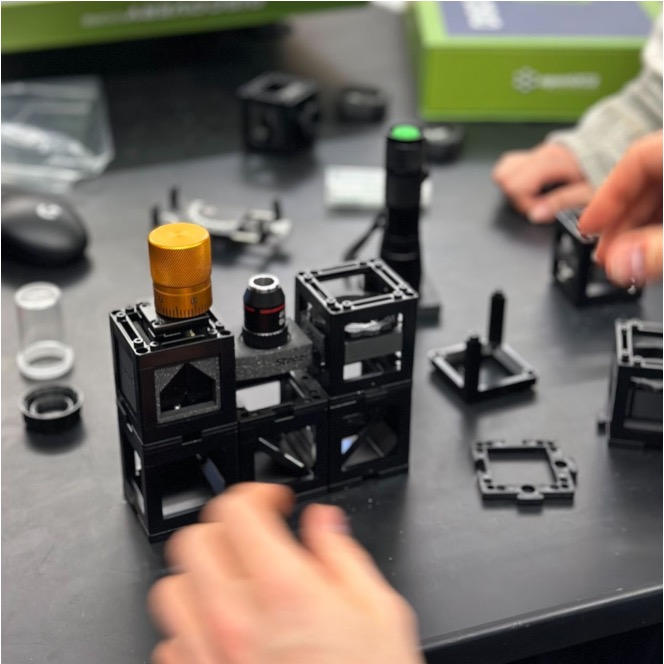 The CoreBox: some cubes, lenses, puzzle base plates and the torch.
What's in the box?
| # | Component | What it's for |
|---|---|---|
| 1 | 2× 45° mirror (fixed, front-surface) | Fold the beam path, e.g. to look from above |
| 2 | 2× 50 mm lens (converging) | Magnifier, eyepiece, objective, condenser |
| 3 | 1× 100 mm lens (converging) | Tube lens, telescope objective |
| 4 | 1× −50 mm lens (diverging) | Galilean telescope eyepiece |
| 5 | 1× eyepiece (Ramsden type) | Comfortable viewing with the eye |
| 6 | 1× objective lens 4×, NA 0.1 (finite, RMS thread) | The "real" microscope objective |
| 7 | 1× Z-stage (25 mm travel, geared) | Fine focusing |
| 8 | 1× sample holder | Holds microscope slides with magnets |
| 9 | 1× universal smartphone holder | Turn your phone into the camera |
| 10 | 1× torch (flashlight) with holder | Transmitted-light illumination |
| 11 | 10× puzzle base plates | Click cubes into stable setups |
| 12 | 2× prepared microscopic samples + 1 blank slide for DIY sample prep | Something to look at |
| 13 | Tweezers, pipette | Prepare your own samples |
| 14 | Ruler / calibration target | Measure distances and calibrate magnification |
| 15 | M3 screwdriver, lens cloth | Assembly and lens care |
| 16 | QR code card | Links straight back to these pages |
(Always up-to-date list: on our shop page)
Full details on every part: Parts and parameters.
What can you build?
At least eight experiments, in two groups:
| Optics | Microscopy |
|---|---|
| Magnifying glass | Infinity-corrected microscope |
| Focal lengths & lens types | Finite microscope with Z-stage |
| Projector | Smartphone microscope |
| Galilean telescope | |
| Kepler telescope (+ spotting scope) |
Where do I start?
This documentation follows Diátaxis and is split into four kinds of page. Pick the one that matches what you want right now:
I want to build something today => Tutorials
Step-by-step, can't-fail walkthroughs. Start here if you have the box in front of you.
- From lens to projector: hold a lens, find its focal length, project an image on the wall. ~30 min.
- Build a telescope: Galilean and Kepler, and why one image is upside-down. ~30 min.
- Your first microscope: the smartphone microscope, yup, build your own microscope in ~45 min.
I know the basics and have a specific goal => How-to guides
Short, practical recipes for one task each.
- Measure the focal length of a lens
- Open and reconfigure a cube
- Build the infinity-corrected microscope
- Build the finite microscope with the 4× objective
- Prepare your own sample
- Calibrate the magnification
- Troubleshoot the smartphone microscope
I want to understand why it works => Explanation
Read these on the couch. No equipment needed. We'll provide you with images and text.
- Light rays and lenses: focal length, converging vs. diverging.
- How images form: real vs. virtual, the lens equation, why the magnifier magnifies.
- How telescopes work: Galilei vs. Kepler.
- How a microscope works: finite vs. infinity optics, and what "4× / NA 0.1" means.
I just need a number or a definition => Reference
- Parts and parameters
- Glossary (English + German terms)
I'm a teacher planning a unit => For teachers
- Teaching with the CoreBox: lesson plans (8 lessons), KMK competencies, classroom organisation, preparation checklists.
A suggested classroom journey
If you're planning a unit, this order matches the physics build-up used in the CoreBox teaching concept ("Didaktikkonzept"):
- Read Light rays and lenses.
- Build From lens to projector: students see a real image appear on the wall.
- Discuss How images form: connect what they saw to the lens equation.
- Build a telescope and let students discover the upside-down Kepler image themselves.
- Build your first microscope and let everyone photograph a sample with their own phone.
- Go deeper with How a microscope works and the infinity / finite builds.
What can you actually observe?
- A letter magnified through a single lens and the exact distance where the effect flips.
- A real image on the wall: enlarged, upside-down, and predictable with one small formula.
- A distant object pulled closer by a telescope you assembled from two lenses.
- Cells and structures in a prepared sample, photographed with your own smartphone.
Safety
The CoreBox contains no laser and no heat source it is designed for unsupervised student group work (age 14+). Two common-sense rules:
- Never look at the sun through any lens or telescope. Ever.
- The torch is bright: don't shine it directly into anyone's eyes.
- And also: If glass ever breaks, don't cut yourself.
Open source
Everything about the CoreBox is open: the hardware (CAD files), the 3D-printing files, and these teaching materials. You may copy, remix, and reprint them for your class. See the openUC2 docs home for licences.
The previous CoreBox documentation (English + Italiano, incl. the PDF manual) is preserved under Archive.