How to fix a clipped or off-centre beam
Task-oriented. Use this when the spot on a card at the objective position is not round and centred, when the scanned image is dark at one side, or when no light comes out of the objective.
Look at the beam
Remove the objective, park the galvo at its centre, put a card on the objective changer and look at the spot (goggles on, laser at minimum power).
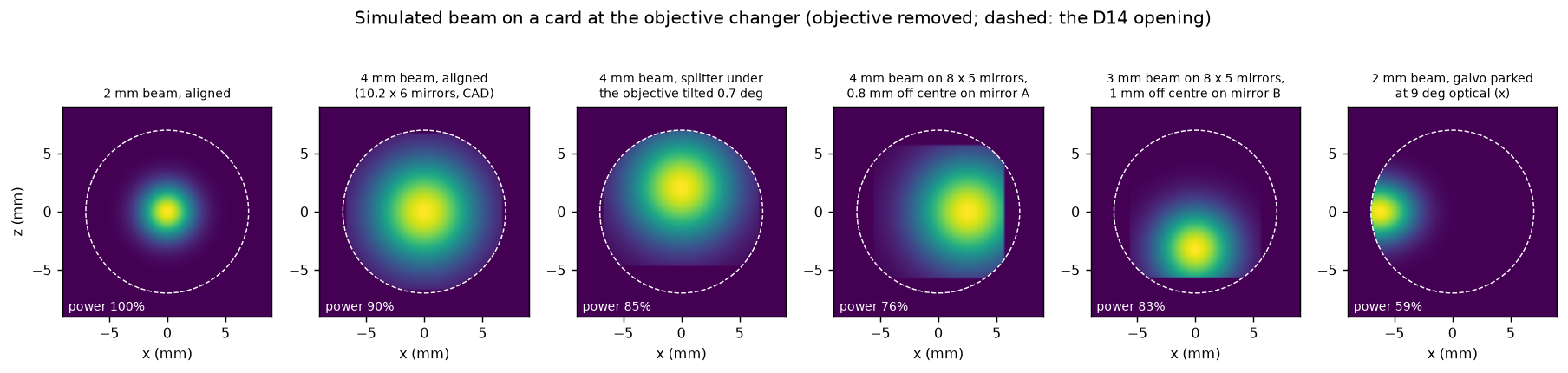 Simulated spot on a card at the objective changer (Optiland model of the module). The
dashed circle is the Ø14 opening. "Power" is the fraction that reaches the card.
The shape tells you which aperture cuts the beam:
| what you see | what cuts it | where to look |
|---|---|---|
| round, centred, a few mm wide | nothing | all good (first image) |
| round but filling the whole opening | a beam wider than about 3 mm at the galvo | step 2 |
| straight edge on one side (D-shape) | a rectangular aperture: the edge of a galvo mirror (or of the splitter) | steps 3 and 4 |
| curved cut, crescent | a round opening: the Ø14 / Ø15.5 holes in the FRAME, a lens mount | steps 1, 4 and 5 |
| nothing at all | galvo not centred (parked at an extreme), not powered, or the laser is off | step 1 |
A straight edge inside the opening needs two things: a beam that reaches a mirror edge (too wide, or off-centre on the mirror) and a beam that is shifted relative to the FRAME opening, so that the mirror's edge is no longer hidden behind the round opening. In the third image, a 0.7° tilt of the splitter under the objective shifts a 4 mm beam enough to show the flat edge of galvo mirror B at the bottom and the round opening at the top.
Step 1 - Is the galvo centred and powered?
- Galvo drivers powered, scanner stopped, beam parked at the centre (your DAC values from the tutorial, default 2048 / 2048).
- A beam parked a few degrees off (last image) is cut by the FRAME openings or misses them completely. Then no light comes out of the objective although the laser is on.
Step 2 - How wide is the beam?
Measure the beam on a card behind the tube lens: it is 3.2 times the beam at the galvo.
| at the galvo | behind the tube lens | effect |
|---|---|---|
| 2 mm (fibre collimator f 11.2, as in the CAD) | 6.4 mm | passes every aperture of the module and the FRAME |
| 3 mm | 9.6 mm | about 1 % loss at the galvo mirrors; fits |
| 4 mm | 12.8 mm | about 7 % lost at the galvo mirrors (10.2 × 6 mm) and 15 % with 8 × 5 mm mirrors; fills the Ø14 opening |
If your beam is about 4 mm, check which collimator is installed. The f 11.2 mm collimator of the CAD gives about 2 mm with a 488 nm single-mode fibre.
Step 3 - Is the beam centred on both galvo mirrors?
Look onto mirror A (upper) and mirror B (lower) from above. The critical direction is across the short side: at 45° the spot is 1.4 times wider than the beam, and a 6 mm wide mirror leaves only 4.2 mm.
- Off-centre on a mirror: re-centre it as in the tutorial, step 4. Use the detection fibre holder and then the junction dichroic, never the galvo offset.
- Measure the mirrors of your galvo. If they are 8 × 5 mm instead of 10.2 × 6 mm, keep the beam at 2-2.5 mm.
Step 4 - Is the beam centred on the opening?
If the spot is off-centre on the card, centre it with the splitter's tip / tilt screws. Then check far above the port that the beam is vertical (tutorial, step 8).
Step 5 - Is the scan range too large?
When a scan, not the parked beam, looks clipped (one side of the image is darker):
- Along x (mirror A) the beam walks across the objective pupil, about 0.4 mm per optical degree. With the 4x the x edges lose 20 % of the power at ±5° optical and 60 % at ±7°.
- Along z (mirror B) the beam stays in the pupil up to about ±7°. Beyond that the tube lens and the splitter start to cut it.
- Keep the scan within about ±4° optical. That is ±1 mm at the sample with the 4x and ±0.45 mm with the 10x. Tile larger areas with the stage.
The DAC range that corresponds to ±4° depends on the galvo drivers. Calibrate it with the scanner-camera calibration (scan parameters).
Why this order
The simulation of the alignment errors (details) ranks the causes. A beam 0.5 mm off-centre on the galvo, a 0.25° tilt of the junction dichroic or a 0.5° tilt of the splitter each cost 15-25 % of the peak intensity. A galvo zero 2° off costs up to 60 % at one edge. Lens positions along the beam hardly matter once you refocus.